Confirm and contextualize in silico predictions with human-relevant in vitro insights.
Inform mitigation, comparability, and formulation decisions with experimental data.
Support regulatory-aligned immunogenicity risk assessment strategies.
De-Risk Development with In Vitro Immunogenicity Insights.
Integrating in vitro immunogenicity assessments into biologic and vaccine development programs provides mechanistic insight into immunogenicity risk throughout the product lifecycle. While in silico analyses offer rapid, sequence-based risk assessment, in vitro assays serve as complementary methods that characterize innate and adaptive immune responses, evaluate critical quality attributes (CQAs), and support more informed decision-making before clinical exposure.
EpiVax provides a comprehensive suite of modular in vitro platforms designed to address specific immunogenicity and immunotoxicity questions. These orthogonal methods align with the growing regulatory emphasis on human-relevant new approach methodologies (NAMs) and enable more confident decisions across candidate selection, product characterization, manufacturing changes, and clinical development.
Assays can be tailored and deployed strategically based on therapeutic modality, development phase, throughput requirements, and the immunological question being addressed. By adapting assay selection to program needs, teams can generate relevant data, investigate emerging risks, and maintain a stage-appropriate understanding of product-specific immune liabilities throughout development.
Whole Blood Assay
PBMC Assay
DC:PBMC Assay
Class II HLA Binding Assay
Assays for Assessment of Generic Peptides
Whole Blood Assay
Evaluates cytokine release from human whole blood following exposure to a test article using multiplexed cytokine analysis (Luminex). Provides early insight into immune overstimulation risk and innate activation mechanisms, bridging in vitro biology with clinical feasibility in a relevant whole blood system. Commonly used to assess potential immunotoxicities due to immunomodulatory therapies (i.e., cytokine storm due to T cell engagers or CAR-T constructs) and innate activation due to critical quality attributes (i.e., impurities, contaminants, aggregates, novel chemistries).
- Modalities: This assay is compatible with conventional and next generation proteins (i.e., mAbs, bsAbs, ADCs, cytokine-based therapies, CAR-T constructs), peptides, nucleic acids, and novel delivery vectors for cell and gene therapies.
- Use Cases: Candidate selection, first-in-human risk mitigation, impurity risk characterization, comparability/manufacturing change assessments, excipient/formulation screening.
PBMC Assay
A modular assay used to evaluate innate and/or adaptive immune responses through cytokine profiling (Luminex or FluoroSpot) and cell activation/proliferation (flow cytometry) readouts. The assay can be customized in scale and design to support discovery, characterization, or specific questions for regulatory submissions. For example, appropriate donor numbers, days of incubation, benchmarks, and readouts can be selected according to stage of development and therapeutic modality of interest. Commonly used as orthogonal support to in silico analyses to assess immunogenic potential of candidates and informing population risk, as well as to assess innate to adaptive priming (i.e., translation of CQA innate stimulation to an enhanced adaptive response).
- Modalities: This assay is compatible with non-immunomodulatory proteins (i.e., mAbs, bsAbs, CAR-T domains, enzymes, hormones, HCPs), peptides, nucleic acids, mRNA/LNP, and viral capsids.
- Use Cases: Candidate selection/optimization, first-in-human risk mitigation, impurity risk characterization, and comparability/manufacturing change assessments.
DC:PBMC Assay
Uses dendritic cell and PBMC co-culture to assess adaptive immune responses in a more mechanistic context through cell activation/proliferation (flow cytometry) and cytokine profiling (Luminex). Particularly valuable for immunogenicity risk assessment of immunomodulatory products. May be simplified to a DC Activation Assay where necessary. Loaded DCs can also be used for an orthogonal immunopeptidomics (MAPPs) readout.
- Modalities: This assay is compatible with immunomodulatory proteins (i.e., mAbs, bsAbs) and peptides (particularly unnatural and cyclic peptides).
- Use Cases: Candidate selection, first-in-human risk mitigation, comparability/manufacturing change assessments, excipient/formulation/route of administration/dose screening.
Class II HLA Binding Assay
A cell-free assay that measures the relative binding affinity of peptides or peptide regions derived from protein sequences to a panel of recombinant Class II HLA alleles, using a fluorescence-based readout. Often used to validate in silico HLA binding predictions and as first-line approach for peptides containing high levels of unnatural amino acids that may not be suitable for computational analysis.
PANDA® Screening
A solution designed for sponsors pursuing the Abbreviated New Drug Application (ANDA) Pathway for generic peptide drugs in which FDA guidance requires sponsors to identify and characterize process and product-related impurities in their drug formulations with innate and adaptive immunogenicity risk assessments.
EpiVax adapted its proprietary in silico and in vitro methods for assessing immunogenic risk to offer Peptide Abbreviated New Drug Application (PANDA®) Screening – a set of orthogonal analyses tailored to specifically meet ANDA sponsors’ immunogenicity assessment needs for generic peptides and their related impurities.
In vitro assays included in the PANDA® Screening program include:
- Class II HLA Binding Assay: Measures the relative binding affinity of API and impurity peptides (or putative T cell epitope regions of the sequences) to Class II HLA alleles.
- T cell Assay: Tests the ability of API and impurity peptides to stimulate a T cell response using human PBMC.
- Innate Immune Response Assay: Used to assess innate immunogenicity of generic and RLD products using human PBMC.
ISPRI Design™
To prepare for in vitro studies, the EpiVax experts can design peptides for synthesis using our advanced in silico tools.
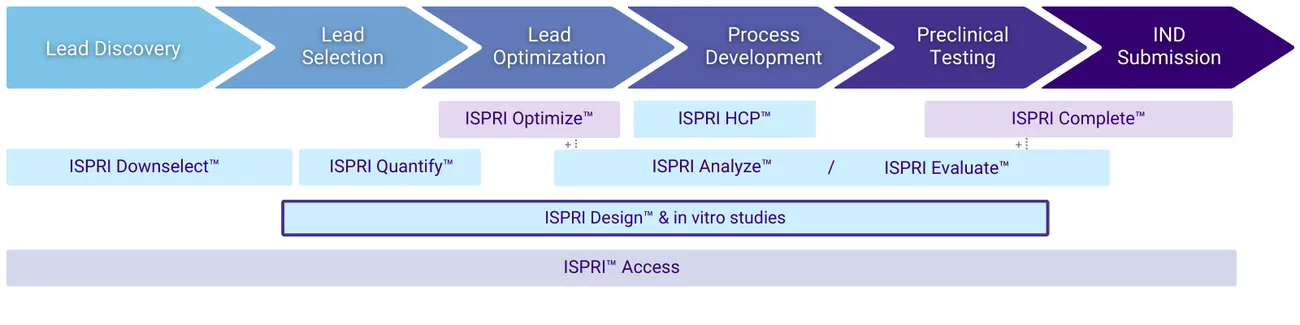
Where are in vitro assessments applied during the development lifecycle?
Lead Optimization
Deimmunization of High-Risk Sequence Regions
Test peptide regions with suggested modifications against relevant controls and a small number of blood donors to rank.
Lead Characterization
Detailed Assessments for IND Preparation & More Comprehensive Risk Profiling
Test whole molecules against relevant controls and a large number of blood donors to inform regulatory submissions and clinical strategy.
Risk Re-Assessment
De-risking of Manufacturing Changes
Confirm the consistency of your therapeutic’s immunogenicity risk profile when scaling from clinical lots to commercial scale manufacturing.
Need human-relevant immunogenicity data to support development decisions? Get in touch!
The EpiVax Roadmap