
Focused Immunogenicity Expertise
Led by renowned key opinion leaders, integrated immunogenicity risk assessment is the team’s core focus. This allows for depth of insight that generalist organizations cannot replicate.
Proven Scientific Track Record
Methodologies supported by decades of peer-reviewed publication, internal and external validation, and real-world application across development programs.
Regulatory and Industry Confidence
Successfully supported sponsors across multiple regulatory filing pathways through long-standing collaboration with agency and pharmaceutical partners—from top global pharma to small biotech.
Best-In-Class In Silico Approach
Industry-leading sequence-based tools focused on identifying and characterizing T cell epitope risk to support early immunogenicity risk assessment and inform downstream bioanalytical, clinical, and regulatory strategy by connecting early sequence risk insights directly to assay design, monitoring plans, and mitigation decisions.
Tailored In Vitro Methods
A suite of modular, scalable assays designed to validate in silico predictions and assess formulation and manufacturing changes and emerging biological signals.
Expert Interpretation, Actionable Insights– Not Just Data
Data is contextualized and translated into development strategy by experienced scientists, not just as standalone outputs.
Clear immunogenicity insights. Better development outcomes.
For more than 25 years, EpiVax has helped developers address immunogenicity through industry-leading, multidimensional analyses that go beyond reactive testing. Supported by decades of peer-reviewed publications, validation efforts, and application across regulatory programs, our philosophy centers around providing a cohesive, risk-based view of immunogenicity across development.
That process begins with sequence analysis using our proprietary ISPRI ™ in silico toolkit to identify, characterize, and mitigate intrinsic T cell epitope content within therapeutic and vaccine candidates and their relevant impurities. Because T cell epitopes are drivers of anti-drug antibody responses, accurate sequence-based insight is critical to building the most actionable risk profile. This cutting-edge technology enables candidate selection, sequence optimization, and rational study design long before costly downstream activities begin.
This predictive data is paired with tailored in vitro assays designed to answer specific questions as programs advance. Rather than relying on one‑size‑fits‑all testing, EpiVax applies a modular and scalable assay strategy to validate predictions, assess formulation or manufacturing changes, and contextualize emerging nonclinical or clinical signals. Together, these capabilities provide a comprehensive risk assessment.
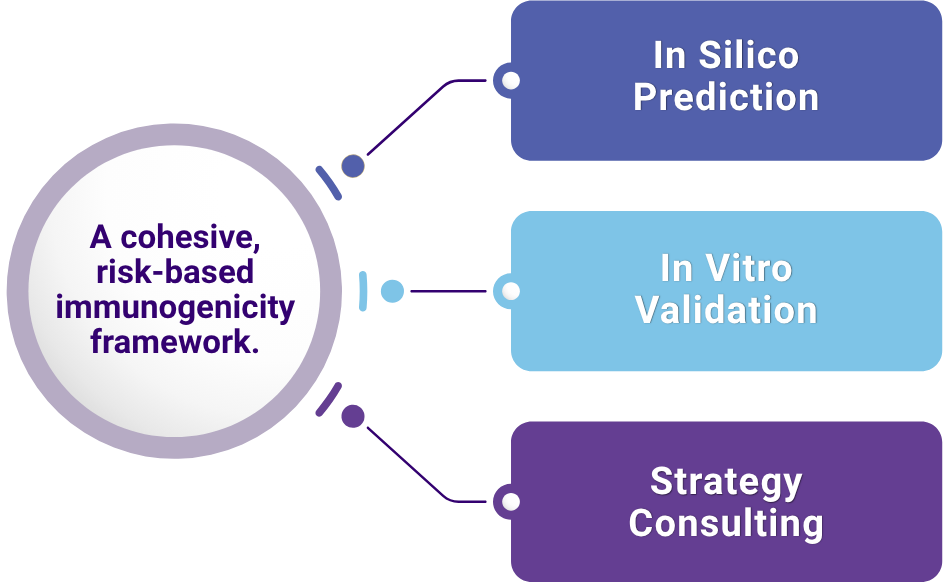
Consulting services bring prediction, experimentation, and strategy together for an integrated immunogenicity assessment, regardless of program stage. This comprehensive model allows access to deep in-house expertise, reducing reliance on disconnected providers and improving continuity in decision-making. Our consultants translate complex data into clear direction and submission-ready narratives by integrating predictive modeling, experimental evidence, and regulatory insight. This approach has supported sponsors across a range of regulatory filing pathways. From discovery through commercialization and beyond, end-to-end immunogenicity expertise is delivered through long-term scientific partnership across the full development lifecycle.
EpiVax is differentiated by its singular focus on immunogenicity risk assessment and the depth of expertise behind it. The team includes industry-recognized Key Opinion Leaders with decades of experience across biologic and vaccine development, spanning discovery, regulatory submission, and commercialization. This foundation is supported by hundreds of publications, a long history of internal and external validation, and sustained collaboration with leading pharmaceutical companies across multiple modalities, enabling a consistent and experience-driven approach to interpreting risk and guiding development decisions. The result is greater clarity in immunogenicity risk, and more confident decisions at every stage of development.
13M+
sequences analyzed
18
of the 20 top pharmaceutical companies served
500+
industry, agency, & academic collaborators
28
years experience
240+