
Understanding Immunogenicity in Biologic Development
What is Immunogenicity?
Immunogenicity is the ability of a therapeutic protein, or related impurities, to provoke an undesired immune response. This response may be driven by sequence characteristics, structural elements, post‑translational modifications, aggregation, formulation components, manufacturing changes, or patient‑specific factors.
Why Does it Matter?
Immune responses to biologics can reduce therapeutic efficacy, alter pharmacokinetics, or result in adverse clinical outcomes. These effects complicate dose selection, data interpretation, and long-term use. In some cases, immunogenicity issues emerge only after substantial clinical investment has already been made.
Regulators therefore expect a structured, risk‑based approach to immunogenicity risk assessment that leverages human-relevant new approach methodologies (NAMs) and demonstrates scientific rationale, appropriate monitoring, and mitigation strategies across development.
When Should Immunogenicity Be Assessed?
Immunogenicity risk assessment is most effective when it begins early, during candidate selection and lead optimization, and continues through preclinical development, clinical trials, and lifecycle management.
Early assessment allows teams to identify inherent risks while there is still flexibility to refine sequence design or prioritize lower‑risk candidates. As development progresses, reassessment supports interpretation of emerging data and helps contextualize clinical findings.
FDA Guidance:
Guidance for Industry: Immunogenicity Assessment for Therapeutic Protein Products
Clinical Pharmacology Considerations for Antibody-Drug Conjugates Guidance for Industry
Clinical Pharmacology Considerations for Peptide Drug Products
Roadmap to Reducing Animal Testing in Preclinical Safety Studies – New Approach Methodologies (NAMs)
EMA Guidance:
Guideline on Immunogenicity Assessment of Biotechnology-Derived Therapeutic Proteins
Early insight offers options: Once a therapeutic reaches the clinic, opportunities to reduce immunogenicity are more limited.
How and When Does Immunogenicity Data Help?
Immunogenicity data provides decision‑enabling insight when generated in the right sequence and applied in context.
In silico assessment is the recommended first step, enabling rapid evaluation and benchmarking of one to many candidates. These sequence-based predictions help to identify regions with elevated potential for immune recognition, compare relative immunogenicity risk across candidate molecules, and help teams understand which sequence features may contribute to predicted responses. These data facilitate early lead prioritization, inform candidate characterization and optimization, and improve the focus of downstream preclinical (in vitro and in vivo) and clinical testing.
In vitro assays are then applied selectively to further characterize and validate, particularly as candidates advance and development questions become more specific. These studies can help confirm predicted liabilities, evaluate the robustness and specificity of immune responses, and provide additional context around potential clinical relevance as development questions become more targeted.
Together, this tiered approach supports informed decision-making while reducing unnecessary expenses or delays.
See how in silico insights and in vitro data work together across development stages
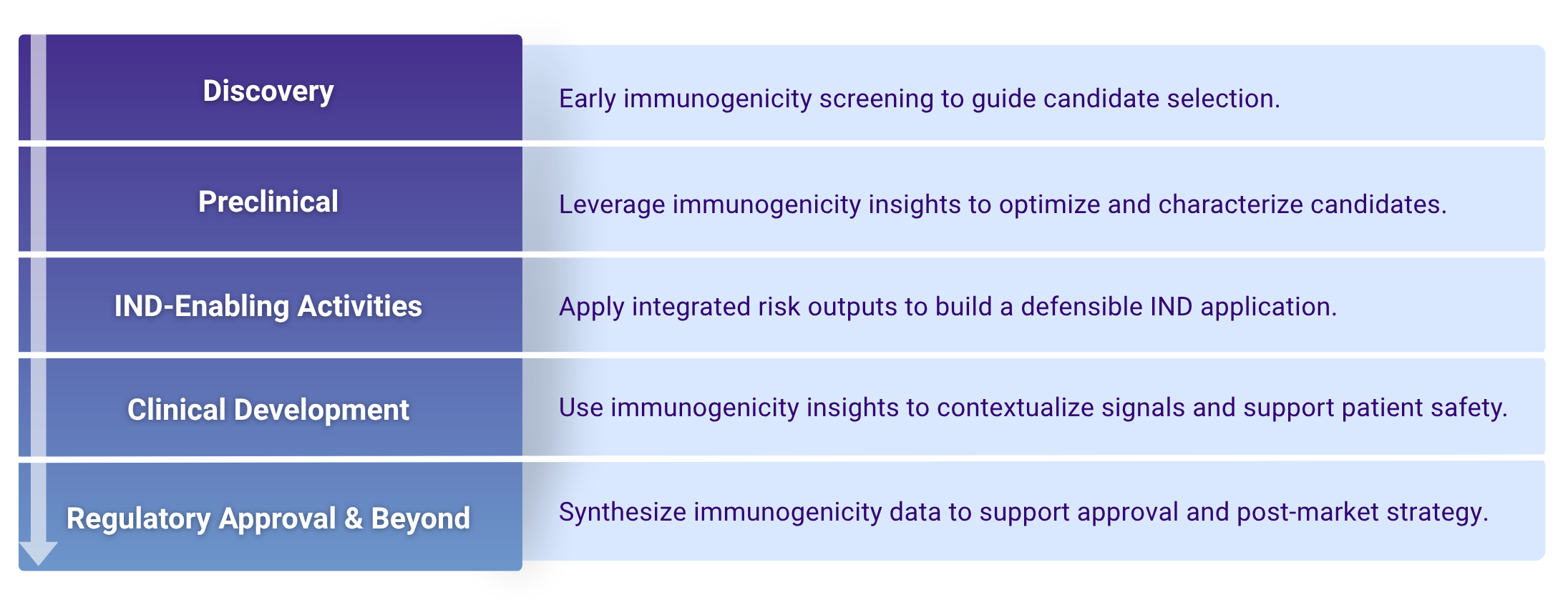
Across the development lifecycle, immunogenicity data supports:
- Prioritization of lead candidates by identifying molecules with lower predicted immunogenic risk early in discovery
- Deselection or re-engineering of candidates with sequence regions associated with elevated immune recognition potential
- Detailed characterization of lead candidates to better understand the nature, magnitude, and potential drivers of immune responses
- Comparison of candidate variants, formulation changes, or manufacturing-related sequence modifications during optimization activities
- Support for in-licensing, out-licensing, or fundraising due diligence packages
- Development of tailored bioanalytical and clinical monitoring strategies based on the specific risk profile of a therapeutic program
- Support for regulatory documentation, including preparation of Immunogenicity Risk Assessment sections for IND submissions and Integrated Summaries of Immunogenicity for BLA or ANDA filings